Connecting greenhouse expansion to berry yield and cash
A controlled-environment berry producer was planning to enlarge its growing footprint while shifting land among several crops. The forecast had to translate area into harvestable volume and sales while recognizing that land, greenhouse systems, people and logistics require cash before a new bay matures.
Only cultivated space is allocated among crops before the forecast calculates harvestable output.
Monthly crop yield, losses, sales timing and selling price build revenue from operating drivers.
Facilities, systems and staff can begin consuming cash before another growing bay produces sales.
Working capital, investment, debt and equity reach the same forecast as crop operations.
WHY THIS WASN’T A TEMPLATE EXERCISE
The model had to respect
how the business actually moved.
The linked architecture turns area and crop allocation into monthly yield, pricing and sales, then carries crop-specific costs, people, greenhouse investment, funding and working capital through the statements, scenarios and return views.
More land did not mean the same thing as more production
The operating footprint included productive and support space, while owned and leased capacity created different cash commitments. The model needed to preserve all three distinctions before allocating a single growing row.
Every crop carried its own seasonal rhythm
Yield and selling price could move by month and by crop. Harvest losses and the delay before sale meant that productive area could not be converted into revenue through one blended annual rate.
Operating costs responded on different bases
Growing inputs and packaging could follow revenue or production volume, while climate-control energy and delivery activity followed their own crop economics. Recurring facility and administrative costs remained separate.
Expansion cash left before the next harvest arrived
Land, greenhouse structures, irrigation, climate systems, lighting, packing equipment and new hires could all be committed before the additional bay generated saleable output.
Crop choice and financing met in the same plan
Reallocating space could change contribution and return, but debt service, equity, working capital and capital expenditure still had to reconcile through cash and the balance sheet.
MODEL ARCHITECTURE
From operating activity
to a decision-ready view.
Each layer has one job. Together they keep the commercial story, unit economics and cash consequences on the same timeline.
Control panel and scenarios
A common setup governs the forecast calendar, operating case, currency, tax, working-capital timing, depreciation and financing assumptions.
Land and productive footprint
Total area divides into cultivated and support space, then into owned and leased capacity with distinct purchase and occupancy economics.
Crop allocation
Editable shares distribute cultivated space among several berry crops while retaining room for additional categories.
Monthly yield and price
Crop-specific harvest yield and selling price preserve monthly seasonality instead of relying on one annual average.
Losses and saleable volume
Yield loss and harvest-to-sale timing translate gross production into the quantity available to generate revenue.
Crop contribution
Growing media, inputs, packaging, energy and logistics remain traceable to the crops and activity that create them.
People and recurring overhead
Role-based hiring, full-time equivalents, compensation and site overhead bring operating capacity onto the monthly timeline.
Investment and depreciation
Land, greenhouse infrastructure, growing systems, packing equipment, vehicles and monitoring assets follow dated spending and depreciation schedules.
Funding, statements and decisions
Debt, equity, working capital and distributions flow through integrated statements into sources-and-uses, scenario, break-even, return, valuation and sensitivity views.
WHAT THE ANALYSIS SURFACED
Useful answers,
without exposing client data.
The takeaways are intentionally qualitative. Exact assumptions, calculations and outputs remain inside the confidential client model.
Expansion was a timing problem before it was a margin problem
A new growing bay could require land, systems and people well before its first saleable harvest. The critical question was not only whether the crop contributed, but whether cash could bridge that lag.
Crop mix changed more than the revenue split
Reallocating productive area also changed monthly yield, losses, pricing, direct inputs, energy and logistics. A crop-mix decision therefore belonged inside the operating engine rather than in a summary table.
Owned and leased capacity created different expansion paths
The same additional growing area could place a very different burden on launch cash depending on whether capacity was purchased or leased, even before crop performance changed.
The downside case needed linked assumptions
Testing price, yield, cost, payroll and fixed expenses together was more useful than moving one isolated total because the expansion decision depended on their combined effect on cash and returns.
MODELING APPROACH
The working system
behind the answer.
- Land, cultivated-area and owned-versus-leased capacity schedule
- Crop-allocation, yield-loss and sales-cycle engine
- Monthly crop yield, selling-price and revenue forecast
- Crop-specific growing, packaging, energy and logistics costs
- Role-based staffing, compensation and full-time-equivalent plan
- Greenhouse, growing-system, packing and vehicle investment schedule
- Depreciation, debt, equity and capitalization schedules
- Working-capital, sources-and-uses and cash forecast
- Integrated income statement, cash flow and balance sheet
- Scenario, break-even, return, valuation and sensitivity outputs
CASE CONFIDENTIALITY
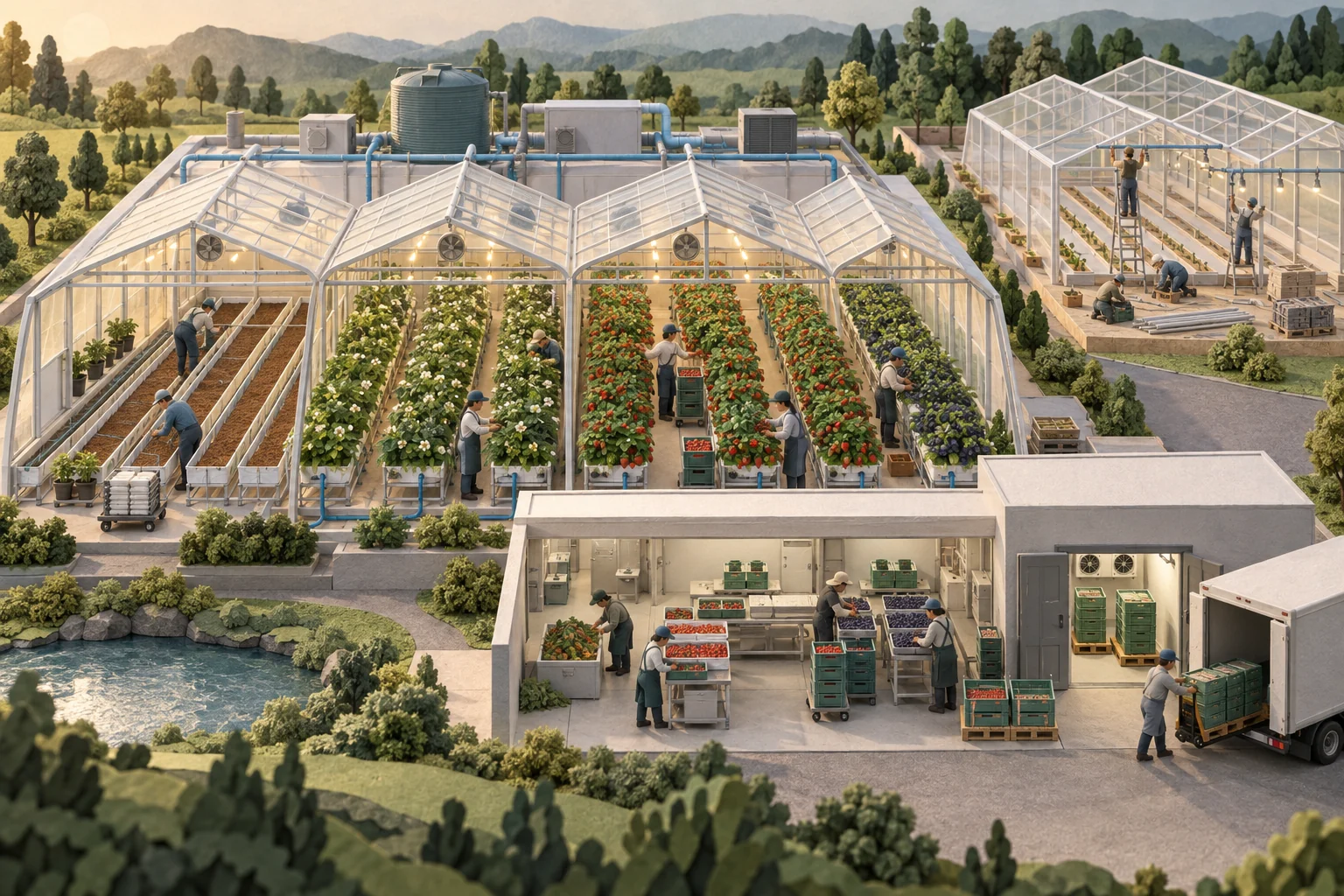
This anonymized case explains the land, crop-mix, yield, seasonality, production-cost, staffing, greenhouse-investment, financing and cash logic without naming the client, company, people, suppliers, location or dates. Exact area, allocation, yield, loss, price, sales, cost, pay, capital, funding, ownership, forecast, break-even, return and valuation assumptions remain private because client work can be confidential or NDA-protected. No workbook screenshot, chart, formula, file name, logo, equipment brand, proprietary crop detail, testimonial or identifying interface is reproduced. The illustration is an original fictional greenhouse operating scene rather than a real farm, facility, client deliverable or operating result.