Testing a destination-hotel redevelopment beyond room revenue
A developer was evaluating the redevelopment of a multi-building destination hotel. The concept paired guest accommodation with food and beverage, events, amenities and shared services, so the business case had to connect market demand and a phased opening to departmental operations, capital needs and investor returns.
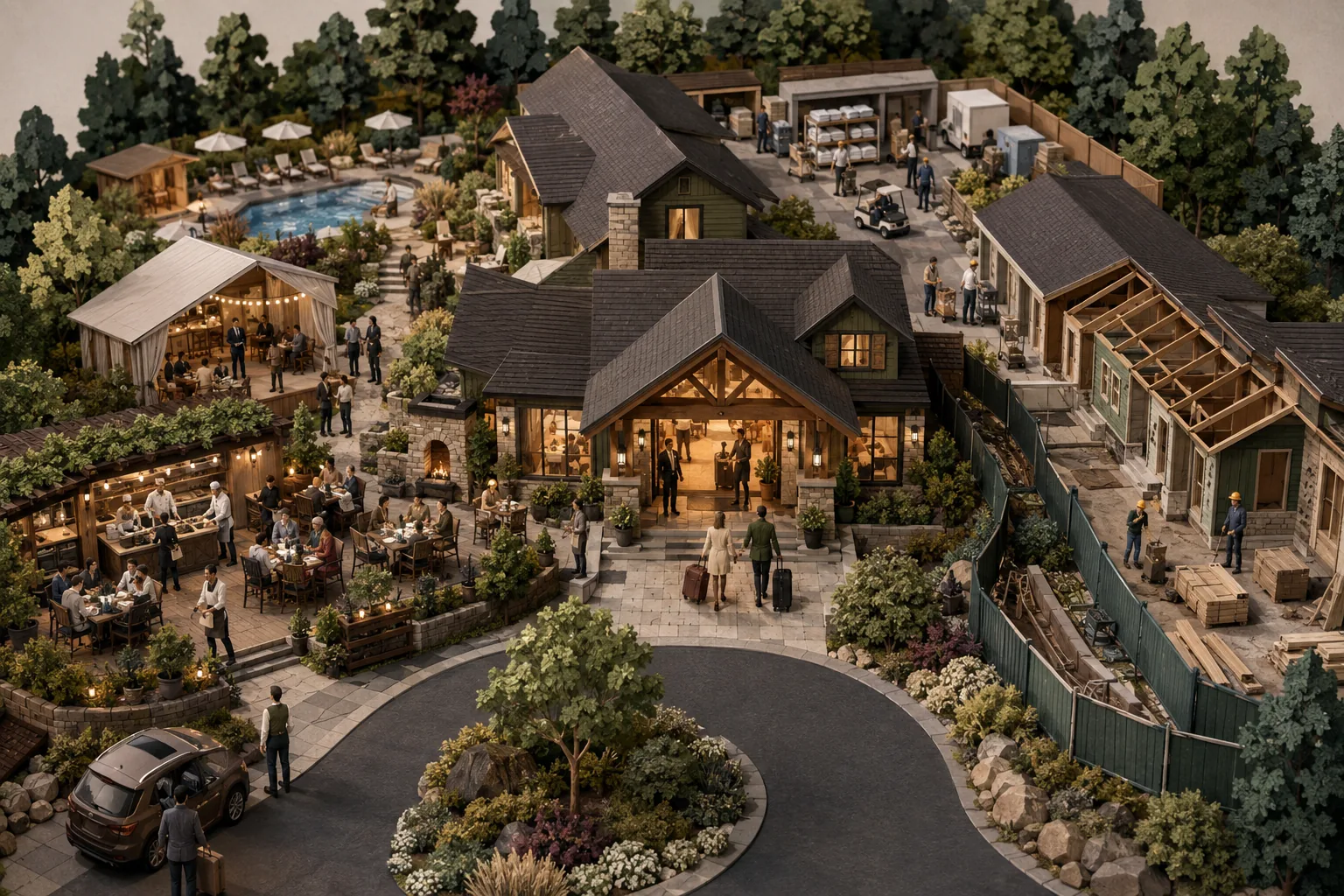
Lodging, dining, events and other guest activity remain distinct before consolidation.
Leisure stays and event-led room nights use different demand and capture assumptions.
Guest capacity, venues and shared services can come online at different times.
Redevelopment, equipment, pre-opening needs and ongoing replacement reserves stay visible.
WHY THIS WASN’T A TEMPLATE EXERCISE
The model had to respect
how the business actually moved.
The reconstructed architecture links demand segments, room nights and rates, venue economics, phased operations, departmental margins, shared overhead, development spending, reserves, financing and exit value. It also keeps capital-budget completeness visible as a condition of the projected return.
Annual occupancy hid the busy nights
A seasonal destination can show a modest annual average while selected weekends and event periods sell out. Monthly demand, day-of-week patterns and unaccommodated demand therefore mattered more than one blended occupancy input.
Non-room revenue carried its own cost base
Restaurants and events could make the property more attractive and generate material revenue, but they also brought labor, purchasing, service and venue costs. Treating them as a simple uplift to room sales would overstate the operating case.
A phased opening disrupted clean annual comparisons
The concept brought guest capacity, dining and event activity online in stages. Partial-year operations, pre-opening spend and shared overhead needed separate timing so an early year was not mistaken for stabilized performance.
An attractive yield could rest on an incomplete budget
The feasibility conclusion depended on the all-in redevelopment cost. Equipment, public-area fit-out, working capital and reserves had to be tested explicitly because a seemingly small omission could materially change investor returns.
MODEL ARCHITECTURE
From operating activity
to a decision-ready view.
Each layer has one job. Together they keep the commercial story, unit economics and cash consequences on the same timeline.
Demand map
Market demand is separated into transient and group segments, then tested across seasonality, peak nights, competitive supply and expected capture.
Room engine
Available room nights, occupancy, average rate and opening discounts build room revenue without assuming the property begins at a stabilized level.
Venue economics
Dining, events and other guest activities use their own volume, revenue and departmental-expense drivers before contributing to the property total.
Operating system
Departmental costs, shared administration, marketing, property operations, utilities and management fees roll into operating cash generation.
Capital plan
Redevelopment work, equipment, soft costs, pre-opening cash and replacement reserves form an all-in view of the money required to open and maintain the asset.
Investor view
Debt, equity, discounted cash flow and an eventual exit translate the operating forecast into a feasibility test with explicit return sensitivities.
WHAT THE ANALYSIS SURFACED
Useful answers,
without exposing client data.
The takeaways are intentionally qualitative. Exact assumptions, calculations and outputs remain inside the confidential client model.
Peak-night demand was more useful than the annual average
Sell-outs on selected nights can support a new property even when annual occupancy appears moderate. The model therefore needed a demand bridge rather than a single top-down utilization rate.
Events supported room demand and added operating complexity
Meeting and event capacity can strengthen group penetration, but the same decision expands food service, staffing and support requirements. Demand upside and delivery cost belong in the same scenario.
Food and beverage could not be treated as a room-rate add-on
When dining is a major part of the guest proposition, its sales and costs can rival the lodging operation. Separate departmental economics keep the headline revenue story from hiding its margin profile.
Budget completeness was the decisive feasibility sensitivity
The projected return could look compelling while remaining highly exposed to missing equipment or fit-out costs. Testing a more complete capital case made the investment conclusion more useful and less fragile.
MODELING APPROACH
The working system
behind the answer.
- Transient, group, seasonal and peak-night demand schedule
- Room-night, occupancy, average-rate and room-revenue engine
- Food-and-beverage, event and other-department forecast
- Phased-opening and shared-services operating schedule
- Departmental P&L, management-cost and cash-generation view
- Redevelopment, equipment, pre-opening and reserve schedule
- Debt, equity, discounted-cash-flow and exit sensitivities
CASE CONFIDENTIALITY
This anonymized case explains the destination-hospitality and feasibility logic without naming the developer, property, group, advisers, operators, team, restaurants, competitors, region, municipality, addresses, dates, research sources or transport links. Exact site characteristics, room and venue counts, layouts, concepts, opening schedule, occupancy, rates, revenue, expenses, fees, development costs, financing terms, valuation and investor returns remain private because client engagements may be confidential or NDA-protected. The source deck, feasibility report, photographs, maps, site plans, renderings, tables, formulas and exact outputs are not reproduced. The illustration is an original fictional hospitality campus rather than the real property or design.