Testing a safety-product portfolio through an acquirer’s channels
A protective-products developer was preparing a revenue-led acquisition story for a mixed portfolio of personal protection, sanitation hardware and connected workplace dispensers. The model needed to translate each potential buyer’s customer access into product volume while keeping current manufacturing terms, minimum orders and optional service income visible.
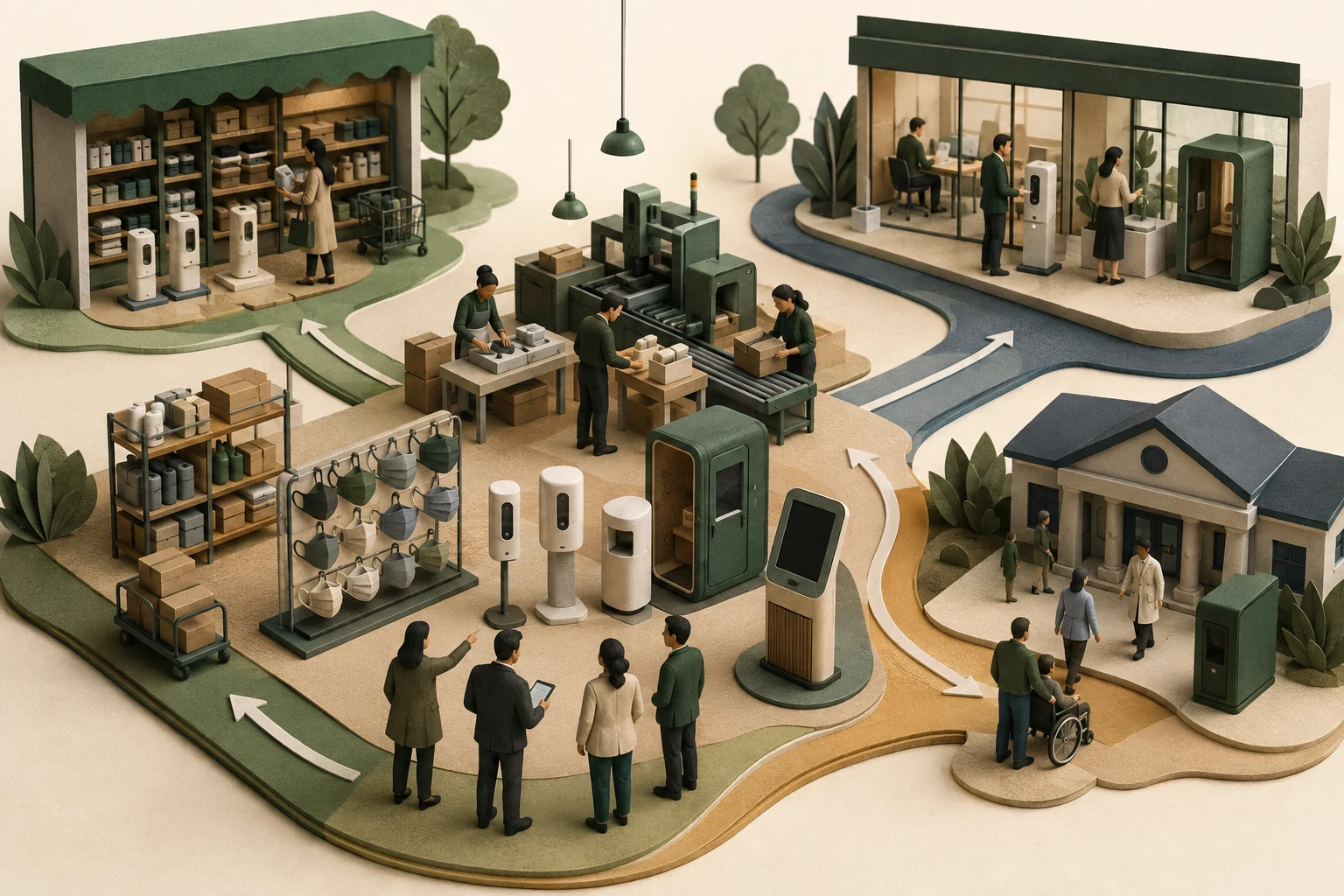
Personal protection, sanitation equipment and connected dispensers required separate volume and price assumptions.
The same product could support different selling prices depending on the buyer and route to market.
Product-specific minimum orders turned customer demand into discrete manufacturing commitments.
Product sales remained separate from customization, setup and potential recurring service income.
WHY THIS WASN’T A TEMPLATE EXERCISE
The model had to respect
how the business actually moved.
The reconstructed architecture separates acquirer reach, account adoption, product and order mix, price layers, manufacturing references and optional fees. This keeps the revenue cases comparable without presenting the seller’s current gross margin as the buyer’s future margin.
Each buyer brought a different revenue map
A product suited to several industries could not rely on one blended sales forecast. Each acquirer scenario needed its own reachable accounts, channel coverage, adoption and product mix.
Current supplier costs did not define buyer economics
The supplied manufacturing terms described the seller’s present sourcing position. A scaled buyer could bring different suppliers, volumes and production capabilities, so current costs had to remain a reference scenario rather than the only margin case.
Variable extras could obscure the core case
Freight, customization and technical setup varied by order and customer. Baking them into one average would create precision the brief did not support, so the base case and optional economics needed separate controls.
MODEL ARCHITECTURE
From operating activity
to a decision-ready view.
Each layer has one job. Together they keep the commercial story, unit economics and cash consequences on the same timeline.
Acquirer scenarios
Each buyer profile defines the customer groups, selling channels and manufacturing advantages that could change the commercial case.
Reachable accounts
Eligible customers, expected adoption and purchasing frequency convert channel access into a product-level demand scenario.
Product and order mix
Demand is allocated across product families and variants, then translated into whole order batches where minimum quantities apply.
Price architecture
Contract, wholesale and retail lenses remain explicit so revenue is not driven by one price that ignores the route to market.
Manufacturing reference
Current outsourced costs provide a baseline, while buyer-scale sensitivities test how different production economics would affect contribution.
Optional revenue
Customization, setup, network access and technical work can be switched on only for the products and buyers that support them.
Decision view
Product revenue, gross contribution and key sensitivities roll up by buyer scenario without turning a forecast into a transaction outcome.
WHAT THE ANALYSIS SURFACED
Useful answers,
without exposing client data.
The takeaways are intentionally qualitative. Exact assumptions, calculations and outputs remain inside the confidential client model.
Distribution fit mattered more than a single market total
A buyer with an existing route into the right workplaces could support a different product mix and adoption path from a buyer with broad retail reach.
Minimum orders made volume lumpy
Customer demand had to be translated into whole manufacturing batches. That distinction affects timing, inventory exposure and the cash needed to support early orders.
Gross margin depended on who owned the supply chain
The seller’s current manufacturing cost was useful as a reference, but it could not prove the economics available to a strategic buyer with different capabilities.
Optional fees belonged outside the base product price
Keeping customization and technical services separate made it possible to test their upside without quietly assuming that every order would include them.
MODELING APPROACH
The working system
behind the answer.
- Buyer-specific industry and channel scenario structure
- Product-family, variant and price input schedule
- Reachable-account, adoption and order-frequency engine
- Minimum-order and manufacturing-batch conversion
- Current-cost reference and buyer-scale sensitivity
- Optional customization and recurring-service schedule
- Consolidated revenue, contribution and sensitivity comparison
CASE CONFIDENTIALITY
This anonymized case explains the acquisition and manufacturing logic without naming the company, founders, product names, intellectual-property claims, dates, supplier locations, customer industries, websites, videos, file links, exact product specifications, minimum orders, costs, prices, fee rates or sourcing alternatives. The source brief, referenced product materials, formulas and exact outputs remain private because client engagements may be confidential or NDA-protected. The illustration is an original fictional product ecosystem rather than a real product, factory, customer site or client workflow.