Planning capacity for a multi-attraction horror venue
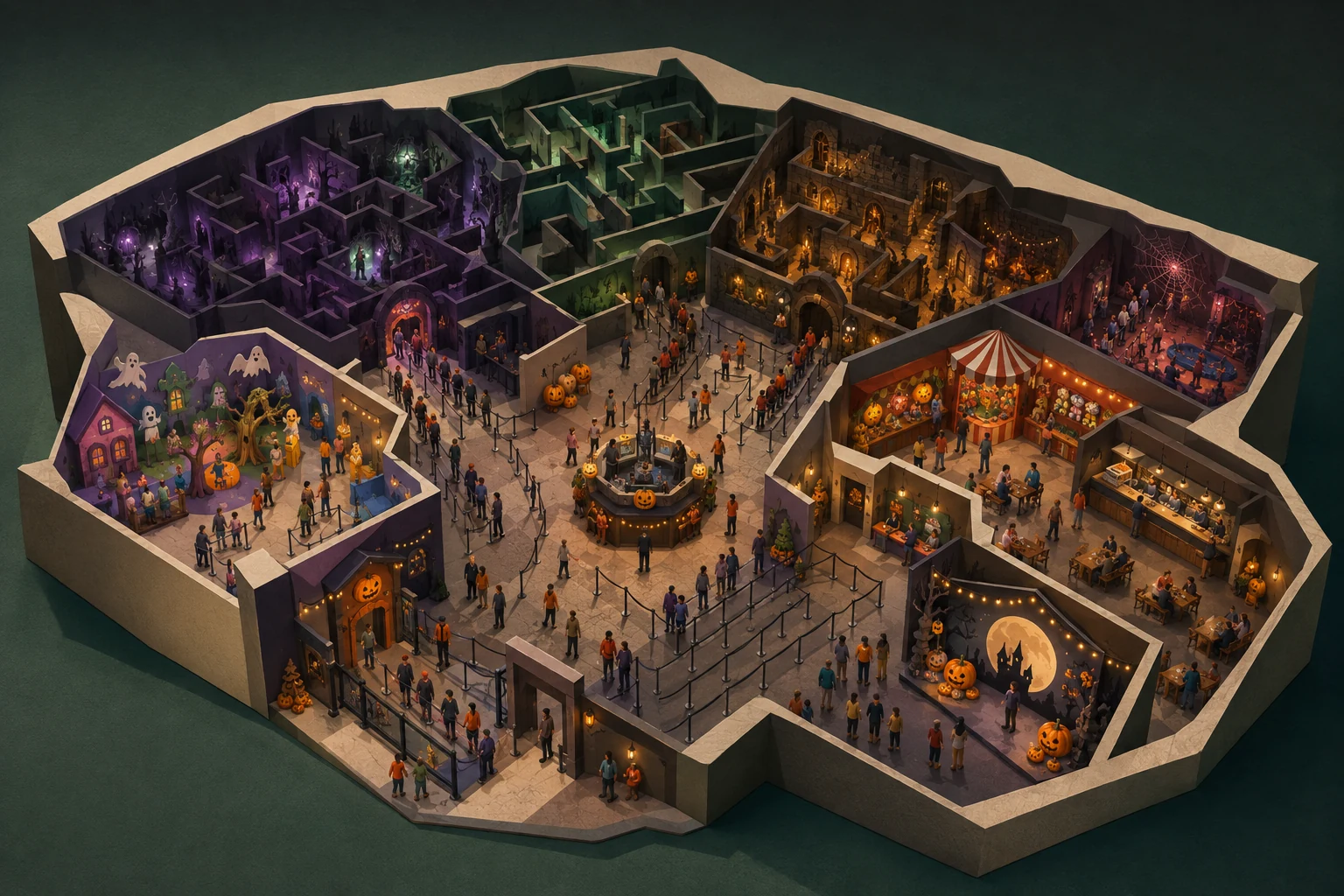
A seasonal entertainment operator was planning a much larger indoor venue with several attractions, time-based tickets, ancillary sales and a strongly last-minute booking curve.
Demand and capacity needed to reconcile at a granular time interval.
A large share of historical demand arrived unusually close to attendance.
Oversell assumptions had to remain explicit and testable by time period.
Each experience required its own group size, cycle time and operating mode.
WHY THIS WASN’T A TEMPLATE EXERCISE
The model had to respect
how the business actually moved.
The model connects the operating calendar, attraction throughput, ticket mix, overbooking and secondary spending to slot-level capacity, revenue and cash.
Every attraction moved at a different speed
A continuous walk-through, a timed group experience and a family zone could not share one simplistic guests-per-hour assumption.
Most demand appeared at the last minute
Because historical bookings arrived unusually late, capacity and marketing decisions had to remain useful close to showtime.
The ticket was only the start of the economics
Admission upgrades, optional protection and secondary spending introduced separate prices, participation rates and direct costs.
MODEL ARCHITECTURE
From operating activity
to a decision-ready view.
Each layer has one job. Together they keep the commercial story, unit economics and cash consequences on the same timeline.
Operating calendar
Dates, opening hours and weekday closure options define the saleable inventory before any attendance forecast begins.
Attraction throughput
Group size, cycle time and accelerated operating modes translate each experience into hourly capacity.
Slot-level demand
Intraday booking slots, day-of-week patterns and late-booking behavior shape the customer arrival curve.
Ticket and upgrade mix
Base admission and optional upgrades convert attendance into ticket revenue.
Ancillary economics
Games, photo packages and food combine participation, price and direct cost with the main operating forecast.
WHAT THE ANALYSIS SURFACED
Useful answers,
without exposing client data.
The takeaways are intentionally qualitative. Exact assumptions, calculations and outputs remain inside the confidential client model.
The main walk-through could process demand continuously
Small groups entering at frequent intervals created relatively high theoretical throughput, but only if staffing and queue release stayed consistent.
Timed group experiences created periodic capacity steps
Larger batches could admit many guests at once, but cycle time created peaks and gaps that the shared arrival schedule needed to absorb.
The smallest timed experience behaved like a bottleneck
A low-capacity attraction needed its own inventory or bundle rule rather than inheriting the venue-wide ticket cap.
The slowest attraction, not the floor area, sets the fragile point
A larger venue can support more total demand, but low-throughput experiences and shared queues still determine where ticket caps and upgrades need guardrails.
MODELING APPROACH
The working system
behind the answer.
- Date, opening-hour and intraday slot engine
- Attraction-level capacity and accelerated-mode schedule
- Admission and upgrade revenue build
- Ancillary sales and direct-cost assumptions
- Overbooking and late-demand scenarios
- Seasonal operating, revenue and cash summary
CASE CONFIDENTIALITY
This anonymized case explains the capacity problem without identifying the operator, season, location or venue. Exact throughput, ticketing and commercial assumptions remain private, and the illustration is a fictional spatial concept rather than a real floor plan.