Structuring a phased investment story for a media-production campus
A proposed media-production campus combined studio infrastructure, supporting real estate, workforce training and future owned content. The investor story needed to show how the first development phase could stand on its own while later phases remained visible as optional upside.
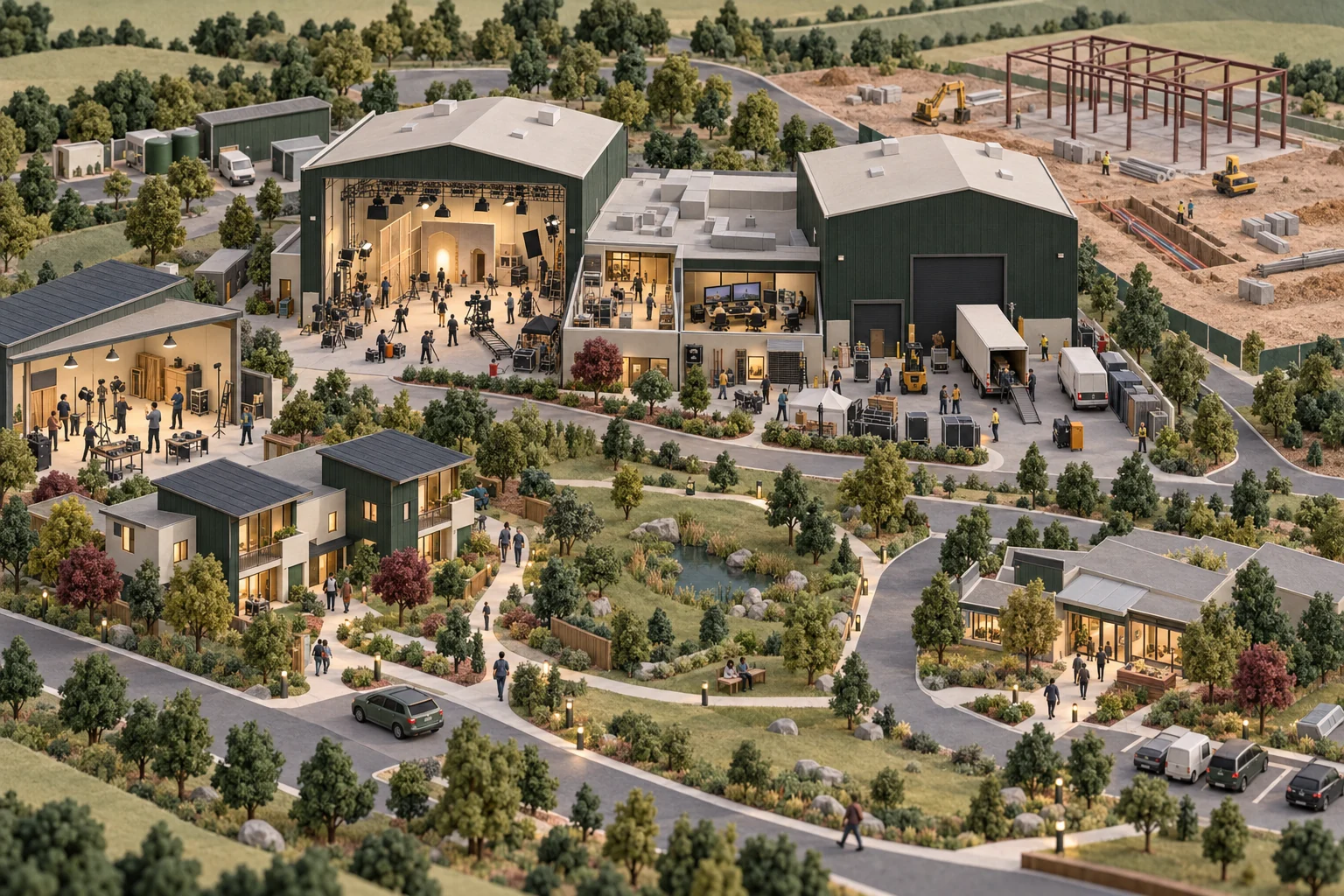
Control, approvals, infrastructure and sale timing precede any land-supported cash case.
Usable days, occupancy and production services turn facilities into operating revenue.
Crew development has lead time and must advance with the booking plan.
Each source of funds belongs to a defined use, milestone and risk window.
WHY THIS WASN’T A TEMPLATE EXERCISE
The investment story
had to respect how the project moved.
The reconstructed decision architecture separates site development, operating capacity, training, optional downstream businesses and funding sources, then aligns each layer with milestones, risks, cash timing and scenario evidence.
The land was both a project site and part of the capital logic
Site control, approvals, infrastructure and parcel timing could influence value and liquidity. Treating the land as immediate cash support would skip the work required to make that value usable.
Buildings alone did not create studio economics
Soundstage days, occupancy, production services, equipment, crew and turnaround capacity all shaped whether completed space could become recurring operating activity.
Workforce readiness had to arrive before demand
Training could support local crew capacity, but programs, instructors and practical experience required lead time. The investor story needed to distinguish that build-up from immediately available labor.
Several businesses shared one vision but not one cash clock
Land development, studio rental, production services, education, housing and future content could begin in different phases and carry different investment, margin and risk profiles.
The funding stack mixed capital with different conditions
Equity, development finance, commercial debt and potential grants could not be presented as one interchangeable pool. Timing, eligibility, cost, security and repayment all mattered.
Return scenarios were sensitive forecasts, not outcomes
Utilization, seasonality, development timing, land monetization and capital cost could all move the projected investor case. The presentation needed to expose those dependencies rather than rely on a headline multiple.
DECISION ARCHITECTURE
From project mechanics
to a decision-ready investment story.
Each layer has one job. Together they keep development, operations, funding and risk on the same sequence.
Phase boundaries and decision gates
The story begins by defining what must be funded, completed and operating in the first phase before later expansion enters the case.
Site control and horizontal development
Acquisition, approvals, roads, utilities and other enabling work form a dated path from raw land to a usable campus and sale-ready supporting parcels.
Land-use and monetization logic
Operating land, supporting development and retained future parcels remain distinct so value creation is not confused with cash available today.
Soundstage capacity and utilization
Available stages, usable days, occupancy and pricing translate the physical build into a transparent studio-rental engine.
Production services and operating capacity
Equipment, post-production, workshops, crew and support services connect bookings to the people and costs required to deliver them.
Training and workforce pipeline
Programs, cohorts and deployment timing show when a local talent pipeline can support operations rather than appearing as instant capacity.
Later business options
Owned productions, additional technology, housing and further property expansion remain separate modules that can be activated only when their milestones and funding are credible.
Sources, uses and financing sequence
Equity, debt and potential public support map to eligible costs, draw timing, interest, repayment and any gap that still requires funding.
Integrated cash and investor scenarios
Development timing, occupancy, services, land sales and financing assumptions converge in downside, base and upside views without presenting any forecast as realized.
WHAT THE ANALYSIS SURFACED
Useful answers,
without exposing client data.
The takeaways are intentionally qualitative. Exact assumptions, calculations and outputs remain inside the confidential client materials.
The first phase needed its own complete investment case
Later studios, content production and property growth could strengthen the vision, but they could not rescue a first phase whose uses, milestones, capacity and liquidity did not reconcile on their own.
Land value did not substitute for operating viability
A development component could support security or future liquidity only after approvals, infrastructure and transaction timing were considered. Studio demand and service contribution still needed independent evidence.
Demand and local readiness belonged in the same conversation
Interest in production space mattered only when access, suitable facilities, crew availability, services and the broader operating environment could support an actual booking.
Optional businesses needed explicit activation gates
Education, owned content, housing and new technology could add strategic value, but separating them from the base case kept cost and upside from arriving before the organization was ready.
A return slide needed a traceable operating bridge
Scenario outcomes became more useful when the reader could move backward from return expectations to occupancy, timing, development proceeds, operating costs and financing assumptions.
PRESENTATION APPROACH
The working system
behind the answer.
- First-phase scope, milestone and decision-gate narrative
- Site-control, approvals and horizontal-development sequence
- Land-use, supporting-development and monetization logic
- Soundstage capacity, occupancy and studio-revenue framework
- Production-service, equipment, crew and operating-cost structure
- Training-program and workforce-readiness timeline
- Separate modules for later production, technology and property options
- Capital expenditure, sources-and-uses and financing sequence
- Downside, base and upside scenario bridge
- Investor presentation flow with assumptions and limitations visible
CASE CONFIDENTIALITY
This anonymized case explains the development, studio-capacity, production-service, workforce, phasing and financing logic without naming the client, company, founders, advisers, supporters, investors, lenders, public bodies, educational institutions, productions, location or dates. Exact land area, site plan, parcel program, development cost, stage count, capacity, employment targets, market comparisons, letters of support, funding terms, ownership, forecast and return assumptions remain private because client work can be confidential or NDA-protected. No presentation slide, map, rendering, photograph, logo, file name, address, contact detail, quotation, testimonial or identifying project term is reproduced. The source presentation was reviewed as planning evidence, not as verification of its external claims or an investment, legal, technical or valuation audit. The illustration is an original fictional media campus rather than a real site, client asset, completed development or operating result.